
American Standard AC Installation in Cape Coral: A Homeowner’s Guide
American Standard and Trane share the same parent company and the same manufacturing plants. So why do two Cape Coral homes with the “same” American Standard system end up with completely different comfort, humidity, and electric bills? The variable isn’t the badge on the cabinet. It’s the installation quality and the system-matching decisions made long before the unit ever gets mounted on a pad. Get those wrong and you’ve paid a premium for equipment that will never perform the way it was designed to.
This guide walks through what actually determines whether an American Standard installation delivers in Cape Coral – the technology, the product tiers, the warranty fine print, and the questions worth asking before anyone touches your home.
Why the Same American Standard Unit Performs Differently in Two Cape Coral Homes
An air conditioner is a matched system, not a single box. The outdoor condenser, the indoor air handler, the coil, the ductwork, and the thermostat all have to be selected together against a load calculation for your specific home. When a contractor skips the load calculation and simply swaps “like for like” based on square footage, the result is a system that’s often oversized. An oversized unit cools the air fast, shuts off before it has run long enough to pull moisture out of the air, and leaves a Cape Coral home feeling clammy at a thermostat setting that should feel comfortable.
This is where installation quality separates a good job from a rushed one:
- Load calculation first. A room-by-room Manual J load calculation accounts for window orientation, insulation, ceiling height, and how much sun a west-facing wall takes on a summer afternoon in Cape Coral.
- Matched components. The indoor coil and air handler should be an approved match for the outdoor unit, not whatever was on the shelf.
- Duct inspection. In older Cape Coral homes, leaky or undersized ducts can waste a large share of the cooling the equipment produces.
- Refrigerant charge by weight. Charging by gauge alone, rather than to the manufacturer’s specified weight, throws off efficiency and coil life.
- Proper commissioning. Airflow and static pressure should be measured and documented before the technician leaves.
None of this is exotic. It’s the standard the equipment was engineered to. It’s just the part that gets skipped when a crew is racing the clock.
How AccuComfort Variable-Speed Technology Works – and Why Installation Makes or Breaks It
American Standard’s AccuComfort variable-speed systems are the reason many homeowners consider the brand in the first place. Instead of cycling on and off at full blast, a variable-speed compressor and air handler ramp up and down in small increments, holding a steadier temperature and running at low, quiet speeds for long stretches. In a hot, humid climate like Cape Coral’s, that long low-speed runtime is exactly what pulls moisture out of the air. Humidity control is the real prize here, not just temperature.
Here’s the catch. That humidity advantage depends entirely on correct setup. If the system is oversized, it won’t run long enough at low speed to dehumidify. If the airflow is set too high, the coil doesn’t get cold enough to condense moisture. If the thermostat isn’t the communicating control the system was designed for, the variable-speed modulation never works the way it should – you’ve paid for a variable-speed system and gotten single-stage behavior.
In our experience, the homes that complain about a “premium system that doesn’t feel different” almost always trace back to one of those setup issues, not a defective unit. When AccuComfort is installed and commissioned correctly, the difference in a Cape Coral summer is noticeable – steadier temperatures, less of that sticky feeling, and quieter operation.
Silver, Gold, or Platinum? Matching the American Standard Tier to Your Cape Coral Home
American Standard groups its equipment into tiers, and the honest answer is that the top tier isn’t right for every home. What matters is matching the tier to your home’s size, how you use it, and how long you plan to stay.
- Silver-tier systems are solid single-stage or two-stage equipment. For a smaller, well-insulated Cape Coral home, or a homeowner on a tighter budget, a Silver system installed correctly will do the job reliably. The money is better spent on installation quality than on an upgrade to a higher tier.
- Gold-tier systems typically add two-stage operation or better efficiency. This is often the sweet spot for a mid-size Cape Coral home that runs its AC hard for most of the year, where the efficiency gain and the gentler humidity control pay back over time.
- Platinum-tier systems, including the variable-speed AccuComfort models, make the most sense in larger homes, homes with rooms that never quite feel right, or households where quiet operation and steady humidity control are worth the premium. In a small, tight house, a Platinum system is often more capability than the home can use.
Notice what’s not on that list: square footage alone. A 2,000-square-foot Cape Coral home with big west-facing glass and a hot attic behaves nothing like the same square footage with shade and good insulation. That’s why the load calculation comes before the tier recommendation.
If you’re weighing a new system against repair, that conversation belongs in a AC installation consultation where someone actually measures your home.
What American Standard’s Warranty Actually Requires From You
The warranty on American Standard equipment is only as good as the paperwork behind it. Two things protect a homeowner here, and both are easy to get wrong.
First, registration. American Standard’s standard warranty terms generally require the equipment to be registered with the manufacturer within a set window after installation to receive the full coverage period – the base coverage that applies without registration is typically shorter. If your contractor doesn’t register the equipment or hand you the documentation, you may be leaving years of coverage on the table.
Second, proper installation records. A warranty claim goes far more smoothly when there’s a clear record of who installed the system, when, and to what specification. Keep the load calculation, the commissioning report, the equipment model and serial numbers, and the registration confirmation together in one folder. If something fails down the road, that folder is what turns a stressful claim into a routine one.
Before any work begins, ask your contractor directly: who registers the equipment, and will you receive written proof of registration? A quality installer answers that without hesitation.
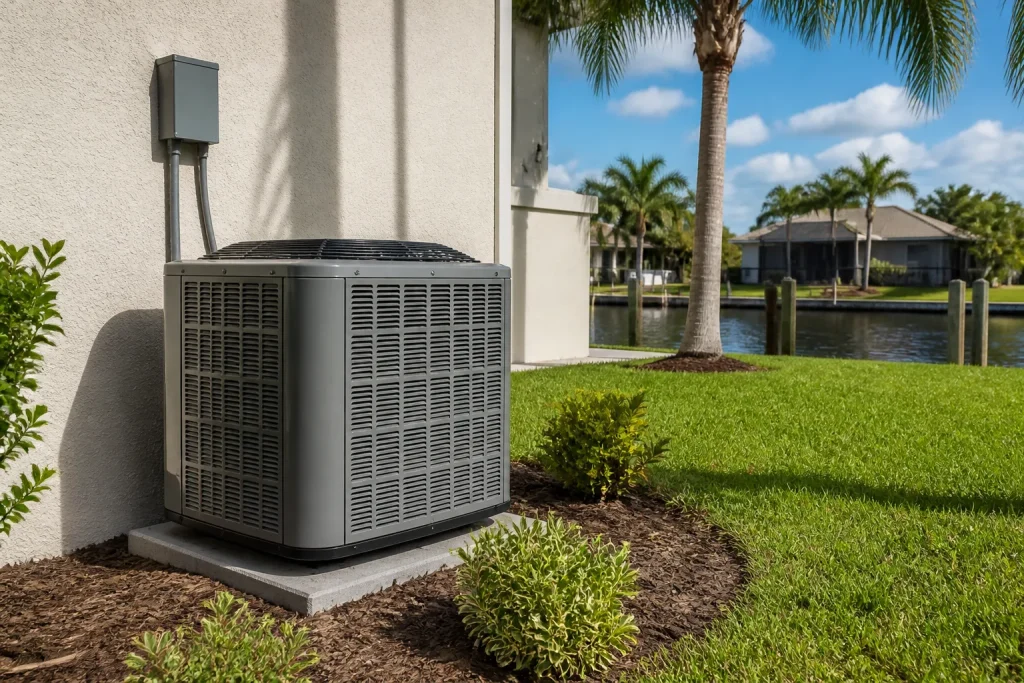
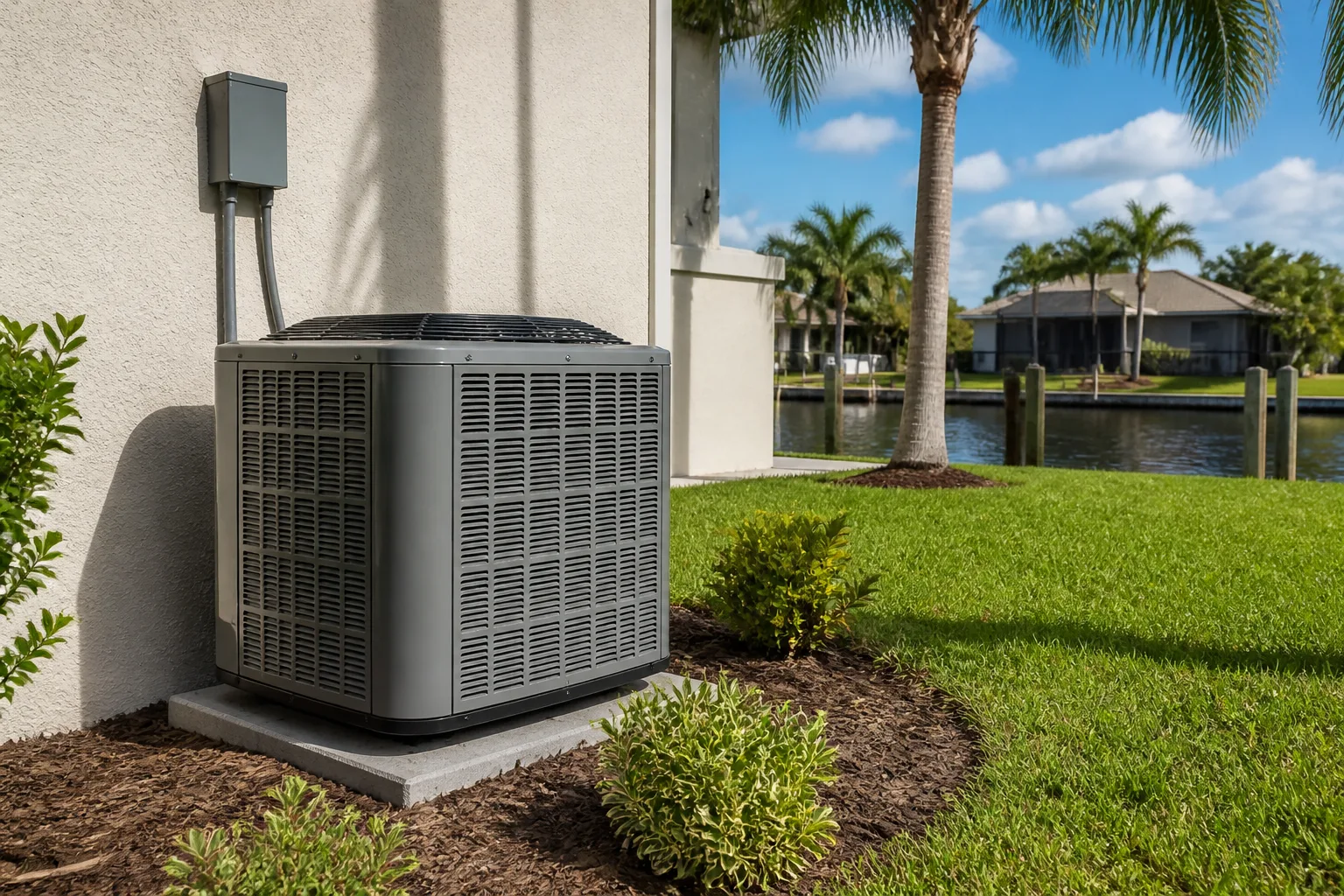
Outdoor Unit Placement in Cape Coral: Shade, Airflow, and Elevation
Where the outdoor unit sits affects how well and how long it works. In Cape Coral, three placement factors matter most:
- Airflow clearance. The condenser needs room to breathe. Crowding it against a fence, wall, or hedge recirculates hot air and makes the compressor work harder than it should. Leave the clearance the manufacturer specifies, and keep landscaping trimmed back.
- Shade without obstruction. A unit in direct afternoon sun runs hotter and less efficiently than one with some shade, but shade plants and structures can’t block airflow. A little strategic shade is good; a cage of shrubs is not.
- Elevation. In low-lying Cape Coral lots, mounting the pad a bit higher than bare grade helps keep the unit clear of standing water and debris during heavy summer rain. Good drainage around the pad matters as much as the height.
Also consider service access. A unit tucked so tightly that a technician can’t get to the valves and panels makes every future service visit harder than it needs to be – and that’s a cost you’ll feel every year, not just once.
Questions to Ask Before You Hire an American Standard Installer
You don’t need to become an HVAC expert to hire well. You need to ask the right questions and listen to how they’re answered. A few that sort a quality job from a rushed one:
- Will you do a load calculation for my home? A confident yes, with a written report, is a good sign. A shrug and a square-footage guess is not.
- Are you an American Standard dealer, and will you register my equipment? Registration protects your warranty, so confirm who handles it and get documentation.
- Is the indoor coil a matched component for the outdoor unit? Mismatched components cost you efficiency and can affect coverage.
- How do you commission the system, and will I get the airflow and charge readings in writing? This is where variable-speed systems live or die.
- What’s your process if the system doesn’t feel right after install? A clear answer here tells you how they handle the rare callbacks.
We work on whatever brand you have, and we’ve seen how the same American Standard unit can be a joy or a headache depending on who installed it. Our technicians have up to experience, and we service Carrier, Trane, Lennox, Goodman, Rheem, York, Daikin, Bryant, and American Standard equipment without pushing you toward one brand. Repair comes first; replacement only when it genuinely makes sense.
When to call a pro: if you’re comparing quotes or your current system is struggling heading into summer, get a professional load calculation and estimate rather than guessing from square footage. Electrical work, refrigerant handling, and system commissioning aren’t DIY territory – these are tasks for a trained, insured technician.
Related services in Cape Coral: if a furnace issue is part of the picture, see our furnace repair page. For more about the area we work in, visit Cape Coral, and to see our full lineup of heating and cooling services, start with Linden AC Repair.
The Bottom Line
American Standard makes solid equipment, and in Cape Coral’s heat and humidity, a correctly installed AccuComfort variable-speed system is a genuinely good investment. But the brand only sets the ceiling – the installation and matching decisions determine whether you actually reach it. Get a load calculation, match the tier to your home (not just its square footage), confirm who registers your equipment, and ask the five questions above before anyone starts. Do that, and you’ll get the system you paid for.
If you’re in Cape Coral and need help, Linden AC Repair offers free estimates – call (855) 595-4793. We answer 24/7. Fast dispatch from 7am to 7pm, Sunday through Friday.
Frequently Asked Questions
Yes. American Standard equipment, especially the variable-speed AccuComfort line, handles Cape Coral’s heat and humidity well when it’s sized and installed correctly. The brand shares manufacturing with Trane, so the equipment quality is solid; the difference you’ll notice comes down to installation quality and system matching. Call (855) 595-4793 for a free estimate.
You should insist on one. A room-by-room load calculation accounts for your home’s insulation, windows, ceiling height, and sun exposure, and it’s the only reliable way to size the system correctly. Skip it and you risk an oversized unit that cools fast but never dehumidifies properly. Call (855) 595-4793 – estimates are free.
American Standard’s warranty generally requires the equipment to be registered with the manufacturer within a set window to get full coverage, and proper documentation of the installation protects you if a claim arises. Ask your contractor who registers the equipment and get written proof. Call (855) 595-4793 to talk through your options.
Placement matters in Cape Coral. The unit needs clearance for airflow, some shade without obstructions, good drainage, and elevation above low-lying spots so heavy summer rain doesn’t pool around it. Service access matters too – keep the valves and panels reachable. Call (855) 595-4793 for help evaluating your placement.
Written by the team at Linden AC Repair.
Need HVAC Help?
Call Linden AC Repair - licensed & insured, here with fast help in Cape Coral.
(855) 595-4793